Challenge
The industrial group wanted to address the energy needs of both plants as one coherent project. Each site had different conditions, but the result was to be a common technology standard, monitoring and service regime.
Case study
Two rooftop PV plants at plants of the same group, unified in technology and approach, including an upgrade of the lightning protection.
Anonymised reference · Poříčany and Mimoň · published 2026
From brief to result
Challenge
The industrial group wanted to address the energy needs of both plants as one coherent project. Each site had different conditions, but the result was to be a common technology standard, monitoring and service regime.
Solution
XENIUM delivered a 660 kWp PV plant in Poříčany and a 412.16 kWp plant in Mimoň. Both sites use a unified technology concept, and both projects included modification of the air-termination system using insulated HVI conductors.
Result
The two plants gained a combined 1,072 kWp of output, unified monitoring and the same service procedures. PV safety and lightning protection were designed as one whole, not as two separate deliveries.
At a glance
Two manufacturing plants received the same technology concept. For the customer, this means similar operation, service procedures and spare parts at both sites; generation split between east and west better follows the shift pattern.
Technical overview
Technical data
The examples are based on design documentation for typical solutions. They explain the principle of the solution; specific documentation is always prepared according to the building, the operation and the grid connection conditions.
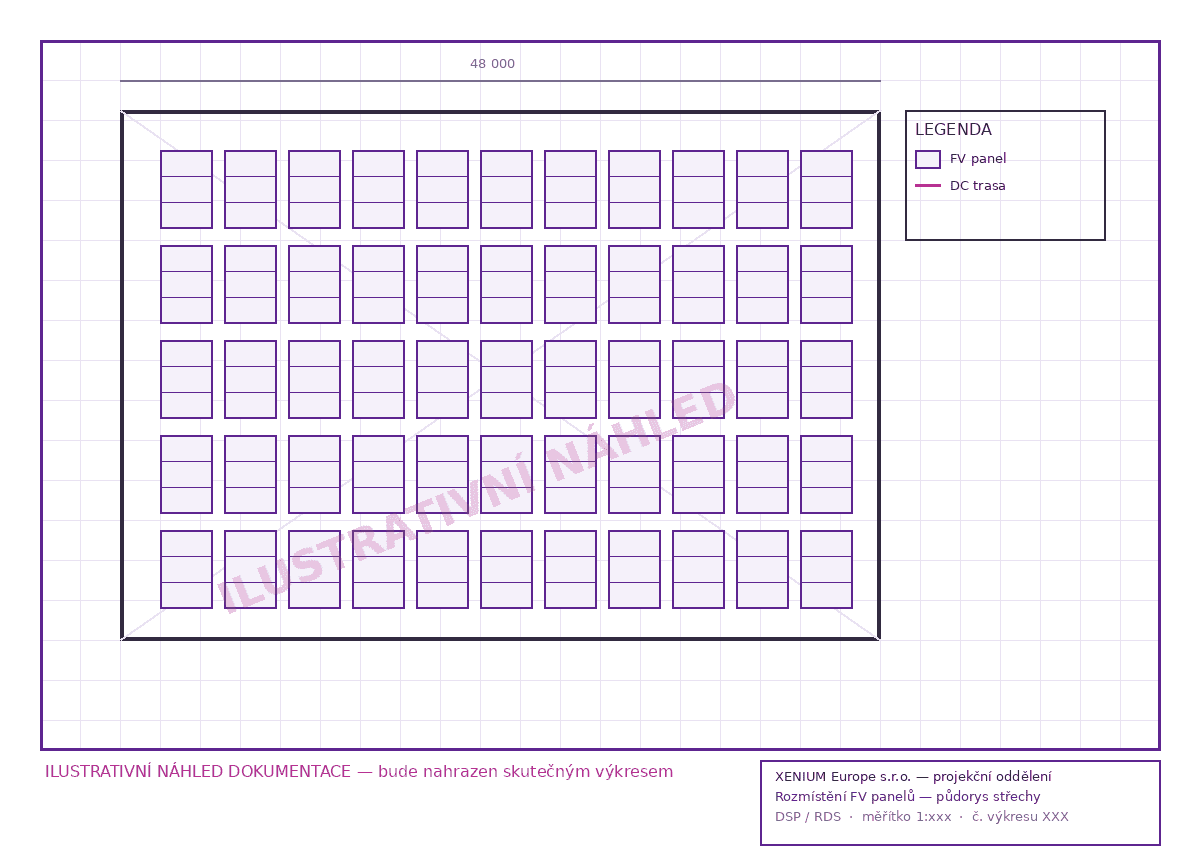
Illustrative design diagram: on the drawing, the designer verifies the usable area, spacing, service corridors and the routing of DC cables. This is not the actual drawing of this specific project.
Project story
01 · Two sites
The power plant in Poříčany has an output of 660 kWp, the installation in Mimoň 412.16 kWp. The unified concept simplifies monitoring, spare parts management and service procedures across the group.
Experience from the first completed site could be applied directly to the follow-on project. The multi-site project was thus not a set of isolated contracts but a gradually built energy standard.
02 · Roof safety
Panels change both the use of the roof and the requirements for lightning protection. On both buildings, the air-termination system was therefore modified using HVI conductors, which make it possible to safely maintain the required separation distances from the PV equipment.
Bringing the electrical installation, photovoltaics and lightning protection under one responsibility limited clashes between trades and preserved the usable roof area.
What matters about the project
a multi-site contract with one standard of workmanship
integration of PV with building safety modifications
relevant for industrial groups and holding companies
Anonymised case study of a completed XENIUM project.
Related references
A layered energy project for a manufacturing site, where photovoltaics, new lightning protection and gradual replacement of lighting followed one another.
View the case studyLong-built trust of a large retail chain, proven at three sites and extended with battery storage in a modified shipping container.
View the case studyAn energy system for an operation where a power outage must not stop cooling and endanger the vacuum hardening equipment.
View the case studyFrom a reference to your project
We combine PV, BESS, VESU+ and supporting infrastructure into one design.
Go to productsWe professionally compare options from the documents you provide before recommending the output and investment.
How the professional assessment worksBasic information about your consumption and project goal is enough. We will propose a meaningful next step.
Arrange a consultation