Decisions without guesswork
We model BESS economics from real 15-minute consumption data, the tariff, reserved capacity and operating peaks.
Free analysis and simulation
We verify whether a battery storage system makes real economic sense in your operation. No rule-of-thumb shortcuts – based on data, tariffs, peaks and the future operating scenario.
What clients ask most often
Does a BESS pay back even without a large PV system?
What capacity should I choose for peak shaving?
Does a battery with VESU+ pay off more than one without control?
How sensitive is the project to changes in electricity prices?
since 2009
Energy in practice
55,000+ kWp
Photovoltaic installations
10,000+ kWh
Battery storage
BESS in practice
A brief look at how battery storage, energy management and project economics fit together. The specific power, capacity and payback always depend on the data of the given operation.
Simulation output
Compare how the investment, annual economic benefit, number of cycles and simple payback change as capacity increases.
Case study
A 99 kWp PV plant was complemented by a Huawei LUNA 241 storage system (115 kW / 241 kWh) and Volteon VESU+ control. Depending on generation, consumption and the price signal, energy is stored, used or sold.
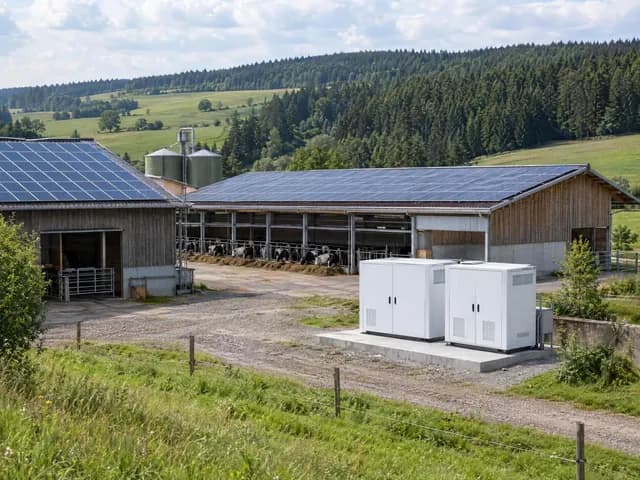
CZK 104,946
net benefit in 5 months
45 %
of the farm's consumption covered
CZK 2,712/MWh
difference between purchase and sale price
~4–6 years
expected BESS payback
The result is based on the farm's specific operation. The benefit of a BESS is always verified against the consumption, generation, prices and control settings of the given site.
How the result is produced
We clarify the project goals and operational context.
We take over consumption, tariffs, peaks and PV data.
We model the power, capacity and control strategy of the BESS.
We compare options, benefits, risks and the sensitivity of the result.
We hand over the project economics and the recommended next steps.
Why this service matters
Every operation has a different consumption profile, tariff, demand peaks and goals. That is why it makes sense to simulate first and invest only afterwards.
We model BESS economics from real 15-minute consumption data, the tariff, reserved capacity and operating peaks.
We quantify savings, expected revenue and the project's sensitivity to changes in electricity prices, the capacity charge and the operating pattern.
We don't just look at the technology, but at the right capacity, power, operating strategy and links to PV, EMS and flexibility.
Proven in operation
See the different ways a battery can be used: from large retail and backup for critical technology to gradual capacity expansion.
3 projects, 2 MWp of photovoltaics and a 1,080 kWh BESS
Three projects from 2021, 2022 and 2025 created a portfolio with an output of approximately 2 MWp. The repeat cooperation confirms the ability to maintain consistent quality, monitoring and service across several operations of one customer.
View the case study192 kWp PV + 226 kWh battery + LED lighting
One project delivered on-site generation, backup for critical equipment and lower lighting consumption. The energy system thus reduces running costs while limiting the risk of damage during a grid outage.
View the case study218 kWp PV and batteries expanded to 416 kWh
The total BESS capacity reached 416 kWh. The expansion after the first operating phase shows a practical way to scale storage according to the actual load and the customer's experience.
View the case studyInputs and outputs
We don't need dozens of documents. Basic operating data is enough for us to quickly assess whether it makes sense to move to the next phase.
Typical scenarios
Reducing demand peaks, stabilising operation and preparing for power control.
Greater use of on-site generation, less export to the grid and smarter handling of prices during the day.
Modelling revenue from flexibility, aggregation and combining BESS with larger energy systems.
Preparing for new technologies, EV charging, expanded generation or a change in reserved capacity.
How we work
The goal is not to deliver another PDF, but a basis for a real investment decision and the subsequent technical design.
Interval data, invoices and basic information about the operation are enough. If needed, we will help you find them.
We compare several BESS sizes, different control strategies and links to PV, VESU+ EMS or flexibility.
We show the payback, annual benefit, key risks and sensitivity to future developments in prices and operation.
If the project makes sense, we follow up with the technical design, financing, delivery and service.
Link to the technologies
If a battery makes sense, we design it in the context of the entire operation. We address energy management, the link to PV and the right way to deliver the project.
Choosing the right solution, from compact batteries to MWh-scale containers.
Predictive control of consumption, generation and storage in 15-minute intervals.
CAPEX, service, shared revenue or a combined model depending on the investor's goal.
Connection to PV, production operations, EV infrastructure or planned site expansion.
FAQ
For companies, industrial sites, investors and clients with photovoltaics who want to verify the economics of a battery storage system before deciding.
No. The purpose of the simulation is first to verify the economic and operational sense of the project, and only then to choose a specific technology.
Yes. For projects where the battery alone is not enough, we also compare a scenario with VESU+ energy management and predictive control.
A summary of the input data, the proposed BESS configuration, modelled benefits, the economics, recommended scenarios and further recommendations for your decision.
Non-binding enquiry
If you already have invoices, metering data or a basic idea of the project, we will build on them and prepare the next step.
Continue according to your goal
Combine generation, storage and control according to the needs of your operation.
View the solutionBased on the operating data you provide, we prepare a professional assessment of the right output, savings and technology size.
How the professional evaluation worksBasic information about your consumption and project goal is enough. We will propose a meaningful next step.
Arrange a consultation