Challenge
Vacuum hardening depends on precisely controlled water cooling. A power outage in the middle of a cycle can ruin the parts being processed and endanger the equipment itself, so the project had to deliver both savings and energy resilience.
Case study
An energy system for an operation where a power outage must not stop cooling and endanger the vacuum hardening equipment.
Anonymised reference · Czech Republic · published 2026
From brief to result
Challenge
Vacuum hardening depends on precisely controlled water cooling. A power outage in the middle of a cycle can ruin the parts being processed and endanger the equipment itself, so the project had to deliver both savings and energy resilience.
Solution
XENIUM connected a 192 kWp PV plant with a 226 kWh indoor battery storage system operating in island mode. The BESS is intended primarily as backup for the water cooling; the project also included replacing the operation's lighting with LED.
Result
One project delivered on-site generation, backup for critical equipment and lower lighting consumption. The energy system thus reduces running costs while limiting the risk of damage during a grid outage.
At a glance
Here the battery is not just about savings. During a grid outage it must keep the water cooling of the vacuum hardening plant running so that neither work in progress nor the equipment itself is damaged.
Technical overview
Technical data
The examples are based on design documentation for typical solutions. They explain the principle of the solution; specific documentation is always prepared according to the building, the operation and the grid connection conditions.
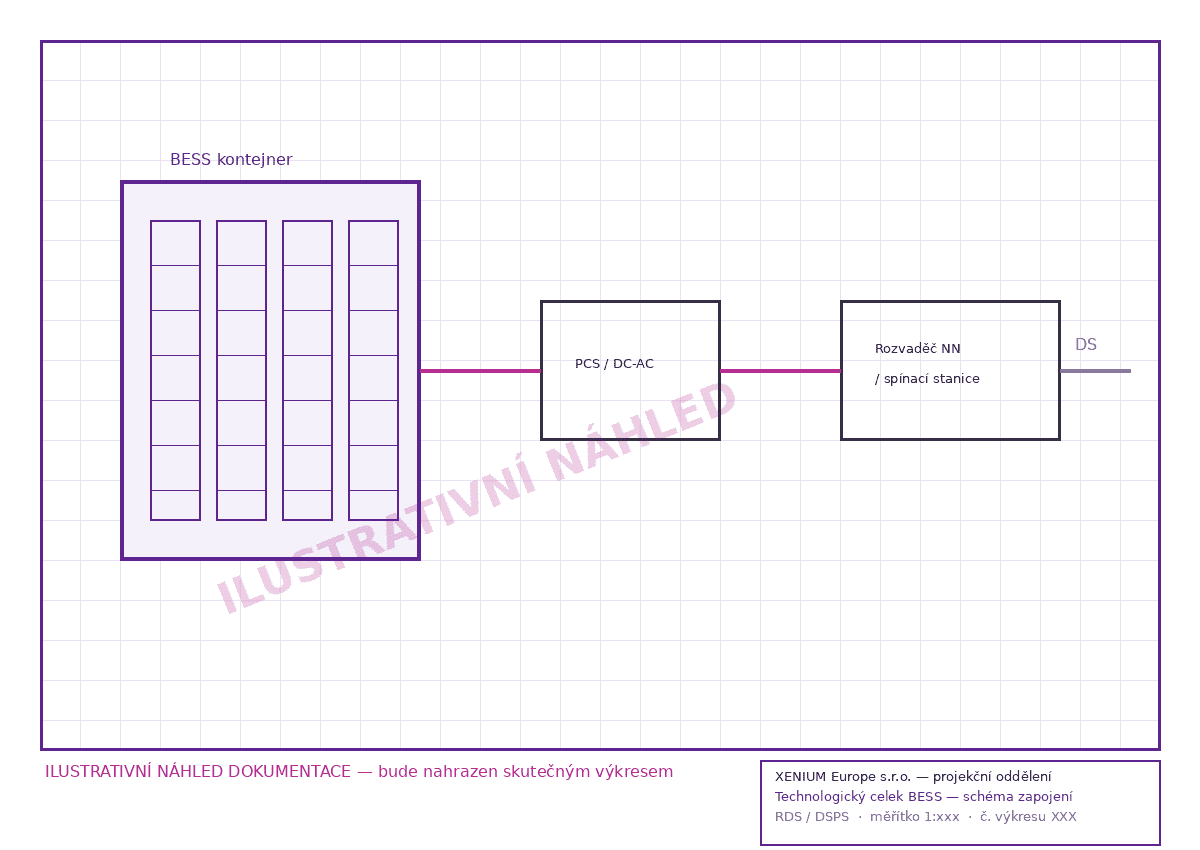
Illustrative design diagram: the battery container is connected to the distribution board and the distribution grid via the PCS power unit. The actual connection is always designed according to the power, operation and grid connection conditions.
Project story
01 · Critical operation
For a vacuum hardening plant, electricity is not just a cost item. It powers a process whose interruption can affect the entire batch in progress as well as the safety of the equipment.
That is why the battery was not designed just for time shifting. Its key role is to keep the water cooling running when the distribution grid is unavailable.
02 · Complete delivery
Photovoltaics with east–west orientation spread generation over a larger part of the day. The indoor BESS stores energy and creates a backup layer for the critical equipment.
The LED lighting upgrade also reduced the site's own consumption. The project thus combines three different benefits, none of which works in isolation.
What matters about the project
an island system for a technologically critical operation
the battery as insurance against outages
a combination of savings and operational security
Anonymised case study of a completed XENIUM project.
Related references
A layered energy project for a manufacturing site, where photovoltaics, new lightning protection and gradual replacement of lighting followed one another.
View the case studyLong-built trust of a large retail chain, proven at three sites and extended with battery storage in a modified shipping container.
View the case studyA project for meat processing, where photovoltaics and storage protect continuous refrigeration and reduce costs at the same time.
View the case studyFrom a reference to your project
We combine PV, BESS, VESU+ and supporting infrastructure into one design.
Go to productsWe professionally compare options from the documents you provide before recommending the output and investment.
How the professional assessment worksBasic information about your consumption and project goal is enough. We will propose a meaningful next step.
Arrange a consultation