Challenge
A shared roof can generate enough energy, but the separate metering points of individual apartments complicate its use. If the PV supplied only the corridors and lift, much of the roof's potential would remain unused.
Case study
Two apartment buildings where the main problem was dividing generation between individual households and making maximum use of energy in the building.
Anonymised reference · Třinec · published 2026
From brief to result
Challenge
A shared roof can generate enough energy, but the separate metering points of individual apartments complicate its use. If the PV supplied only the corridors and lift, much of the roof's potential would remain unused.
Solution
In both buildings, the metering points were merged into one main meter and the apartments' consumption is sub-metered. Each building received a 20.48 kWh battery; in Třinec, a Watt router also uses the surplus for water heating.
Result
The two installations have a combined 38.4 kWp and approximately 41 kWh of battery capacity. The generated energy can supply both the common areas and households, the battery covers evening consumption and, in Třinec, further surplus heats water.
At a glance
Instead of electricity from the roof powering only the corridors and lift, each building functions as a single customer. Energy can be used in the apartments, stored in a battery for the evening and, in one of the buildings, also sent to water heating.
Technical overview
Technical data
The examples are based on design documentation for typical solutions. They explain the principle of the solution; specific documentation is always prepared according to the building, the operation and the grid connection conditions.
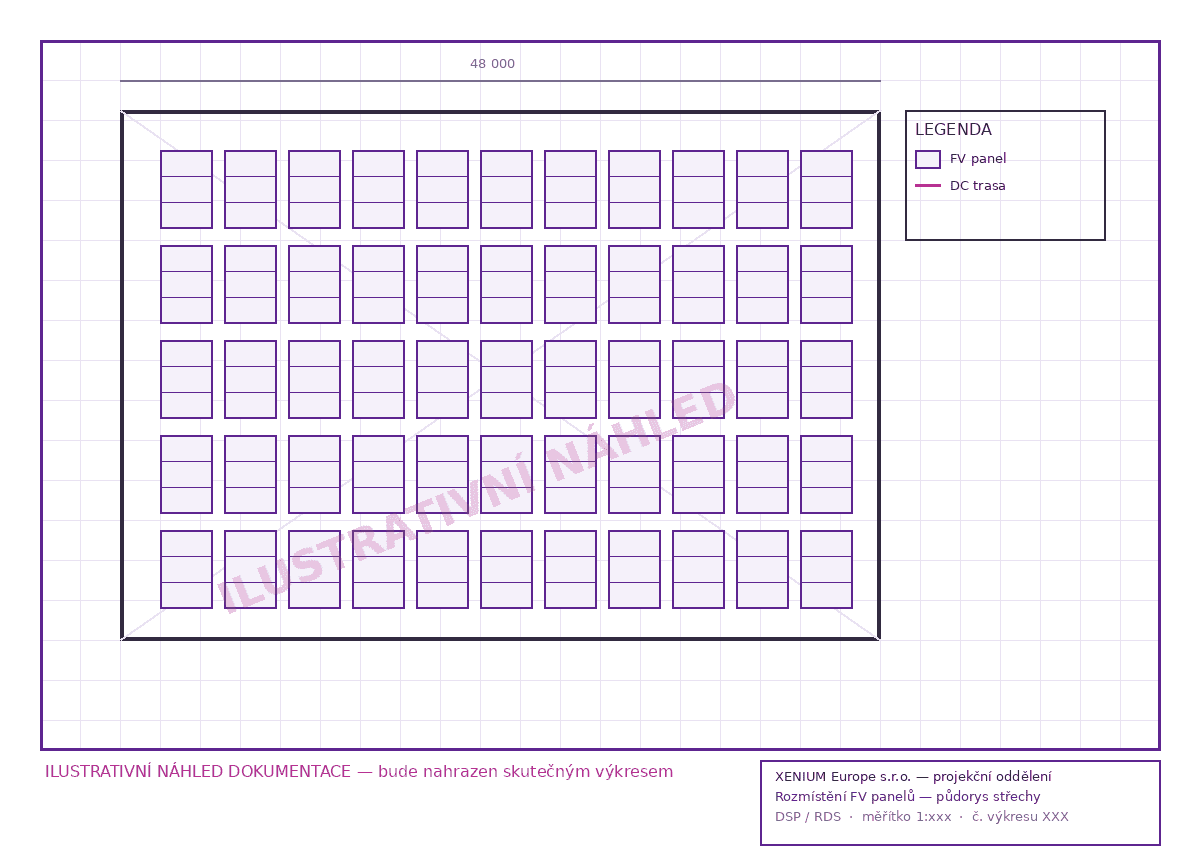
Illustrative design diagram: on the drawing, the designer verifies the usable area, spacing, service corridors and the routing of DC cables. This is not the actual drawing of this specific project.
Project story
01 · Shared roof
Instead of dozens of separate metering points, each building acts as a single customer towards the distribution system operator. Sub-metering then divides consumption between individual households.
Thanks to this arrangement, generation is not limited to corridor lighting and the lift. Electricity from the roof is used throughout the building and the remaining energy purchase is handled jointly.
02 · Using surplus energy
Both buildings use a hybrid inverter and a Growatt ARK 20.48 kWh battery. Energy generated during the day therefore remains available in the evening, when households return and consumption rises.
The Třinec building also has a Watt router that sends further surplus to water heating. The water heater thus takes on the role of an additional storage element without unnecessarily exporting usable energy to the grid.
What matters about the project
a solution for direct use of energy in the apartments
a battery and smart water heating as multipliers of generation use
practical verification of the merged metering point model for homeowners' associations
Anonymised case study of a project for apartment buildings.
Related references
A portfolio of five different residential projects showing that PV can be adapted even to technically complicated buildings.
View the case studyFrom a reference to your project
We combine PV, BESS, VESU+ and supporting infrastructure into one design.
Go to productsWe professionally compare options from the documents you provide before recommending the output and investment.
How the professional assessment worksBasic information about your consumption and project goal is enough. We will propose a meaningful next step.
Arrange a consultation